The Classroom
The bacterial flagellar motor, laid out as a room: the specimen bench holds the real molecules, the whiteboard carries the mechanism and the honest ladder, the frequency wall lists every timescale this estate actually holds, and the mind–body wall separates what is measured from what is inferred from what is predicted. Every number on these walls carries its source; every image says what it is.
 THE WHITEBOARD
the D–L–T mechanism · the eight-rung ladder
MIND–BODY WALL
body · mind · the third mind
measured / inferred / predicted
FREQUENCY WALL
every timescale held here
38 rows · ratios · φ
Specimen Bench
the real molecules — 115,000 deposited atoms
THE WHITEBOARD
the D–L–T mechanism · the eight-rung ladder
MIND–BODY WALL
body · mind · the third mind
measured / inferred / predicted
FREQUENCY WALL
every timescale held here
38 rows · ratios · φ
Specimen Bench
the real molecules — 115,000 deposited atoms
The room itself is scenery — generated imagery, truth-class ILLUSTRATION, provenance in classroom-assets/MANIFEST.json. It depicts no data. Everything hung on it carries its own source.
The specimen bench — the parts as objects
These are not drawings. Every line below traces actual deposited atom positions from the two cryo-EM structures this estate holds, at one true physical scale (1.4 px/Å) so the relative sizes are real. Click any part for its full provenance. Two species, never blended: the rod-and-hook is Salmonella; the stator is B. subtilis. Neither is an E. coli measurement, and each card says so in the source's own fence.
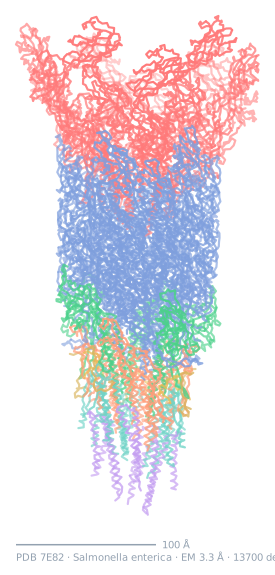
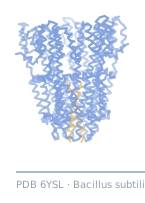
Each protein, alone
Renders are deterministic (two runs byte-identical) and each source file's sha256 is recomputed against the evidence manifest at render time — a mismatch refuses to render.
Where each part sits — the anatomy map
This cutaway is a labelled schematic, not a structure. Parts the estate holds atoms for are solid and clickable; parts with no structure held here are dashed and say so. Geometry constrained by PDB 7E82 (Salmonella) and 6YSL (B. subtilis) — cross-species labels retained.
The motor moving — the two films this estate holds
The whiteboard — the mechanism, and the honest ladder
The one place real mechanism exists in this estate is the stator-binding process from the Wadhwa 2022 paper, held verbatim with its measured rates. Around it: the eight-rung biological ladder, what is held at each rung, and the finding that reframed this whole programme.
The D–L–T stator mechanism — measured rates, drawn
The ladder — eight rungs of real biology, and what this estate holds at each
The honest headline: the joined depth of this hierarchy, today, is ONE. Eight rungs are nameable from the sources; exactly one has event-level primary data on disk; zero adjacent pairs are joined on one motor and one clock. Everything else is horizontal slices from different cohorts. Naming a rung we cannot reach is how we know what to acquire — that is why all eight are on the board.
Ion flux / proton-motive force NOTHING MEASURED
Held: the structural basis only, and in the wrong species — the MotA₅B₂ stator as atoms (6YSL, B. subtilis, on the bench above). Missing: every dynamic quantity — no PMF, no ion flux, no protons-per-revolution. The one cited anchor (Lo 2018) holds zero bytes here.
Would require: per-cell membrane-potential measured alongside a stator trace.
Single-stator binding state D/L/T/H DECLARED MECHANISM
Held: the authors' mechanism verbatim with all rates (drawn above). Missing: any molecular identity — D, L and T are UNIDENTIFIED_LATENT_STATE by the estate's own structural map, which refuses "a known stator conformation, catch-bond state, or molecular intermediate".
Would require: an independent observable of binding state — FRET, a mutant series, or a structure resolving the states.
Ring occupancy N — the one anchored rung EVENT DATA ON DISK
Held: Wadhwa 2022 — 1,349 dwell events, 129 motors, 50 Hz, the only event-level primary dataset here. Dwell rises steeply with occupancy (8.5 s at N=0 → 99.1 s at N=11); multi-unit jumps are common. Corroborated: Ito 2021 (40 motors), Nord 2017 (load→recruitment), Franco-Oñate 2025, Reid 2006 (≥11 units).
Open question, deliberately unreconciled: Ito's dwell means FALL with N while Wadhwa's RISE. The repo holds Ito's sheet name but not the figure caption — possibly different observables. Not resolved by inference.
Torque and mechanical output OTHER MOTORS
Held: Antani 2021 — nine torque conditions, 9.4 → 1294 pN·nm, with both switch rates at each. Missing, and it is the big one: no torque–speed curve, no knee, no stall torque, no torque-vs-stator series anywhere. The live curve in the released app (stators × 180 pN·nm) is UNSOURCED.
Would require: torque calibration per motor, on the same clock as the stator trace.
C-ring conformation and engagement THEORY ONLY
Held as theory: Mattingly & Tu 2026 — torque exponentially modulates engaged-subunit switching; ported and numerically verified here (column-sum error 8.5e-14) but classified "published INTERPRETATION". Held as picture: the Salmonella switching video (unresolved Johnson/Singh attribution). Missing: no C-ring structure at all — neither held structure contains FliG, FliM, FliN or CheY. The only FliG/FliM/FliN here is a drawn label.
Directional switch CW/CCW STRONGEST RESULT
Held: Antani 2021 — as torque rises 9.4 → 1294 pN·nm, k(CW→CCW) rises 1.12 → 4.02 s⁻¹ with Spearman ρ = 1.0000, k(CCW→CW) rises 0.235 → 0.830 s⁻¹ (ρ = 0.93) — while CW bias barely moves (mean 0.158, CV 0.10). The motor speeds its switching clock under load while holding its directional set-point. Also: Yuan 2009's non-monotone k(CW→CCW) peaking near 120 Hz.
Adverse provenance, displayed: Yuan 2009, Bai 2010 and Zhu 2024 have no DOI, no authors and no title recorded anywhere in this repository, yet count in the 11-study breadth gate.
Chemotaxis input CheY-P ASSOCIATION ONLY
Held: Antani 2021 — stator presence raises the CheY-P signal (Hedges g 0.78, p 0.0008, both required controls retained and null — which is what makes it worth anything). Fenced: "association/coupling, not an unrestricted causal chain." Zhu 2024's values are a fit, and the field name says so. Missing: any measured Hill coefficient or Kd — the released kernel's n=6 and Kd formula are UNSOURCED.
Filament, bundle, whole-cell behaviour PIXELS + NUMBERS
Held as pixels: the Mears 2014 film (on the bench — the only OBSERVED behaviour here). Held as numbers: Lisevich 2025, 106 cells — motor 219.5 Hz, filament 174–195 Hz, body 26–42 Hz, swimming 20–28 µm/s, and motor speed invariant to flagellar number (slope CI includes zero). X09 PASS, fenced as source reproduction.
Population / ecology REFUSED
Nothing — deliberately. No source held here supports a layer above the single cell; building one would be scaffolding. The refusal is part of the design.
The finding that reframed the programme
Our model's layers — population → per-motor → occupancy → hazard — are strata of statistical pooling wearing biological names. Each answers one question: which events share a parameter. A biological hierarchy is a different object: a composition of maps on physical state, each with units — ions/s → pN·nm → s⁻¹. Not one such map exists in the stack, and it is provable by units alone: the only units anywhere in it are seconds and counts.
And the Markov blanket we score is the analyst's, not the motor's — its active set is empty (a = ∅), which makes it a conditioning set, not a blanket. The motor's own blanket — PMF sensing, torque sensing, stator engagement as action — is entirely unobserved in this dataset. Parity of the Markov structure with the biology is the programme's open problem, and it is now stated instead of assumed.
Full statement with per-layer receipts: the models page. The naming ruling (rename the pooling layers vs build the maps) is the operator's and is open.
The frequency wall — every timescale this estate holds
Rendered live from timescales.v1.json, which is extracted programmatically from the artifacts — nothing typed by hand. Units are shown as held: where a source key carries no unit, the wall says so rather than asserting one. Chips: MEASURED DIGITIZED 3RD PARTY MODEL PREDICTION REDUCED MODEL · UNSOURCED NOT HELD
loading the wall…
The layers and their measured tempos — and the ratios
| layer (rung) | measured tempo held here | source | ratio to the layer above |
|---|---|---|---|
| B7 · one flagellar revolution | ~220 Hz → ≈ 4.5 ms | Lisevich 2025, 10 cells | — |
| B5 · direction switch interval | 0.30 – 2.59 s (CCW, by bias) | Bai 2010 via Mattingly, digitized | ≈ 65× – 570× one revolution |
| B2 · stator dwell (one occupancy state) | 0.26 – 357 s · state means 3.2 – 99 s | Wadhwa 2022, 1,349 events | ≈ 10× – 40× a switch interval (means) |
| B2 · stator arrival / departure | σ₊ 0.19 s⁻¹ → ≈ 5.3 s · k_off,loose 0.057 s⁻¹ → ≈ 17.5 s | Wadhwa 2022 | same rung, kinetic view |
| B3/B5 · load adaptation of switching | observed over 22 – 598 s | Antani 2021, time axis | ≈ 10× – 100× a dwell |
| B0 · ion transit / torque stroke | NOT MEASURED — no PMF, no flux, no stroke time held | — | unknown |
Read the ratio column carefully: these are cross-study, order-of-magnitude statements — different motors, different labs, different observables. No two adjacent layers have ever been recorded on one motor and one clock in this estate, so no ratio here is a within-organism measurement.
The cycle-ratio (φ) prediction. The operator's standing hypothesis: between recursively nested layers, the ratio of update-cycle counts follows the golden ratio / Fibonacci structure — φ governs cycles between layers, never the surprisal bound and never the decision rule, and precision is a separate, model-adjustable organ.
What observation would move this: it becomes testable the moment two adjacent rungs are recorded on one motor and one clock — which is exactly what the Antani workbook re-acquisition (above) buys. Until then its status here is PREDICTED, not tested; the measured column above cannot confirm or refute it because every ratio in it crosses cohorts.
The mind–body wall
Three panels, three different epistemic standings — measured, not-established, predicted. The wall's whole point is that the three are labelled differently and never blended.
BODY MEASURED
The motor as mechanism — everything on the bench and the whiteboard. Its strongest measured behaviour: under load it speeds its switching clock while holding its directional set-point (both rates monotone in torque, ρ = 1.00 / 0.93, while CW bias stays near 0.16). Its stators are not fixed parts but a population that binds and unbinds in seconds, remodelling the engine while it runs.
Sources: Antani 2021 · Wadhwa 2022 · Lisevich 2025 · structures 7E82 / 6YSL.
MIND NOT_ESTABLISHED
The same motor read as an inference machine: occupancy as belief, remodelling as belief update, switching as action selection. This reading is the programme's central hypothesis and its gate status is stated exactly: G10 / X12 — does a bacterium implement active inference — NOT_ESTABLISHED. Discriminating interventions run: 0.
And the blanket we currently score is the analyst's, not the motor's: its active set is empty. The mind-reading earns its name only when the motor's own blanket — sensing, action, the conditional independence — is instantiated and tested.
THIRD MIND OPERATOR HYPOTHESIS — PREDICTED
The operator's prediction, stated as his: mind and body stack — left and right minds over one body — and when the two come to hold a higher-order understanding of each other and of future states, a third mind — awareness — arises between them. He predicts this structure is consistent for all life, and for matter as measured, with the flagellum as its smallest complete instance: a body that is also a mind of its own.
What observation would move this: first a real two-rung join (one motor, one clock), then a discriminating intervention where an inference reading and a mechanism-only reading disagree — the P5 experiment already specified in the external-doors checklist. Until then: predicted, attributed, untested.
The conjecture board OPERATOR CONJECTURE — ATTRIBUTED, NOT ASSERTED
Also standing on the operator's board, in his words: that current space-time theory has carried falsified status far longer than acknowledged; that better measures of the passing of experience are needed; and that approaches through a fourth dimension / platonic space may supply them. The estate records these as the operator's open conjectures. It asserts no verdict on them, and no gate in this repository bears on them — which is exactly what this label means.
Every scientific number on this page carries its source inline or in its drawer. The room is scenery; the science is cited. Adverse results are displayed as models, not blemishes — that is the operating contract.